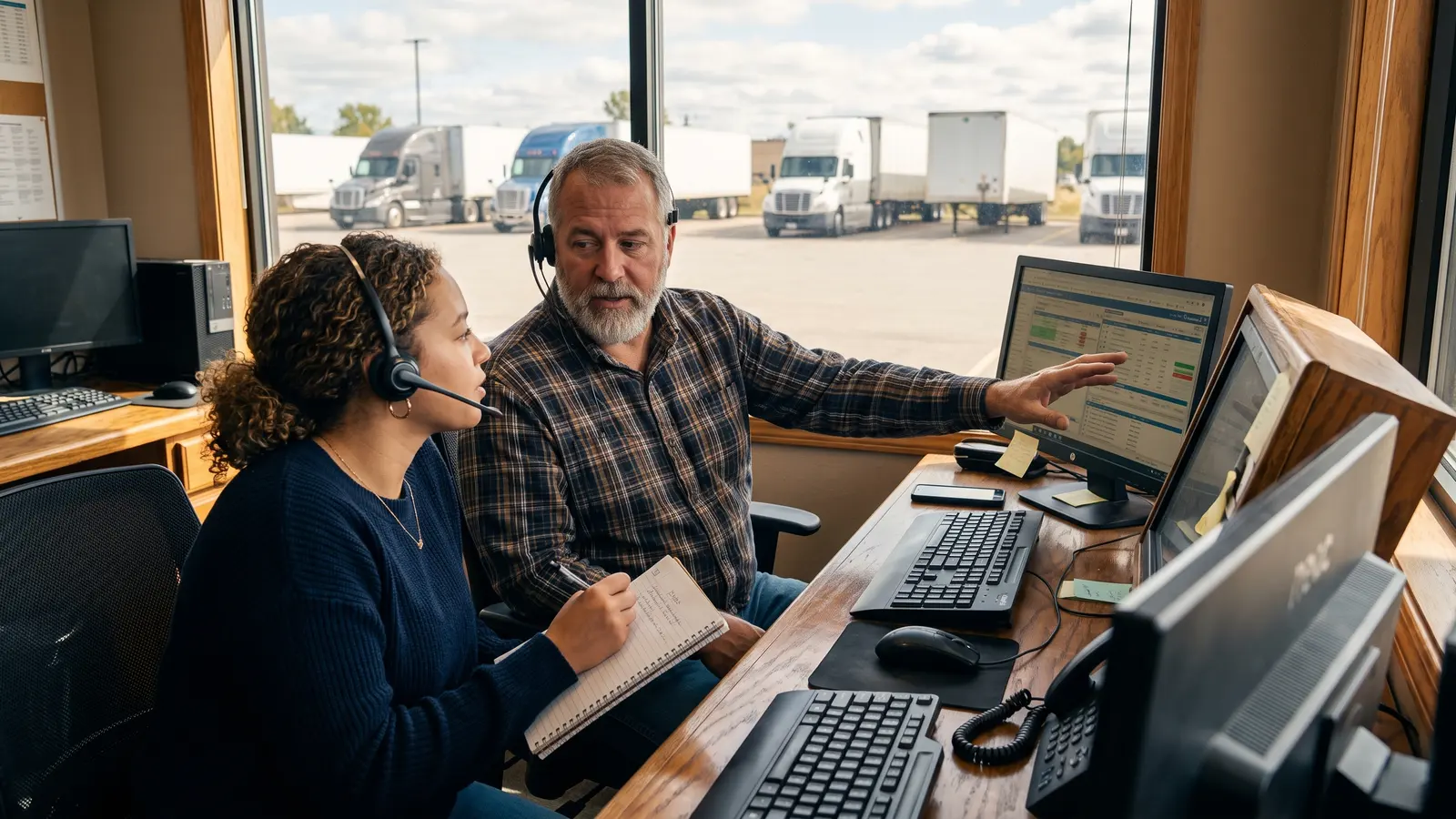

Many small trucking companies hire a truck dispatcher to find loads, negotiate rates and handle paperwork. A good dispatcher can keep a truck moving and take a lot of work off an owner-operator. A dispatcher who isn't set up properly can create problems the carrier doesn't see coming.
The question carriers ask most is simple: are truck dispatchers legal? The honest answer is that it depends on what the dispatcher actually does and how the relationship is set up. This article explains where the line is, using the federal definitions and FMCSA's guidance, and what a carrier should check before signing with any dispatch service.
What a truck dispatcher does
A truck dispatcher, sometimes called a freight dispatcher, works on behalf of a trucking company to book freight for its trucks. Typical work includes:
- Searching load boards and calling brokers for loads that fit the truck, the lane and the driver's hours
- Negotiating rates and reviewing rate confirmations
- Sending pickup and delivery details to the driver
- Handling check calls, delays and detention
- Collecting load documents for invoicing or factoring
Many small fleets and owner-operators use a dispatcher because they don't have an office staff, or because the driver can't book freight safely while driving. That's a legitimate need. The legal question is about how the dispatcher is set up, not whether the work itself is useful.
What the federal rules say
The definitions that matter are in 49 CFR 371.2.
Who is a broker
A broker is a person who, for compensation, arranges or offers to arrange the transportation of property by an authorized motor carrier. Brokers must register with FMCSA and hold broker authority.
Who is a bona fide agent
A bona fide agent is a person who is part of the normal organization of a motor carrier and performs duties under the carrier's direction, under a preexisting agreement that provides for a continuing relationship. A bona fide agent has no discretion to allocate traffic between that carrier and others.
Under 371.2, motor carriers and their employees or bona fide agents are not brokers when they arrange transportation the carrier is authorized to haul and has accepted.
What FMCSA has said about dispatch services
FMCSA issued final guidance on this question, published in the Federal Register as document 2023-13080. In it, FMCSA said a dispatch service can be acting as a broker when it arranges transportation for compensation and doesn't meet the bona fide agent definition. FMCSA also made clear that the answer is fact-dependent. It turns on what the dispatch service actually does, not on what it calls itself.
In plain terms:
- A dispatcher who works for the carrier, under the carrier's direction, under a written agreement for an ongoing relationship, and who doesn't decide which carrier gets which load, is acting much more like a bona fide agent.
- A dispatcher who pulls loads and then decides which of several carriers gets each one, or who is really selling capacity rather than working for a carrier, may be acting as a broker. If that dispatcher has no broker authority, that's a problem.
The label "dispatcher" doesn't settle the question either way. The facts do.
The risks of a poorly set up dispatch arrangement
When a dispatch service isn't clearly working for the carrier, or is acting like a broker without authority, the carrier can carry real risk.
Unclear responsibility when something goes wrong
Every load involves a shipper (the consignor), a receiver (the consignee), usually a licensed broker, and the motor carrier. When a dispatcher sits in the middle with no clear written role, it gets harder to sort out who was responsible for what if there's a cargo claim, a missed appointment or a payment dispute. The carrier is the one whose name is on the rate confirmation and whose truck hauled the load, so the carrier often ends up holding the problem.
Insurance gaps
Ask what insurance a dispatch service carries, such as errors and omissions coverage, and read what it actually covers. Don't assume the dispatcher's policy, if there is one, will respond to a claim on your load. Your own auto liability and cargo coverage are what you'll be relying on.
Payment and rate problems
If a dispatcher is taking compensation from both sides of a load, or isn't showing you the actual rate the broker agreed to, you may be paying more than you think. Insist on seeing every rate confirmation in full, in your company's name.
Poor freight choices
Some dispatchers focus on volume across many trucks. Booking the first load that comes up, without looking at deadhead, the next load out of the delivery area or the driver's hours, can leave a truck working hard for little return. A dispatcher who works for you should be planning around your truck, your lanes and your costs.
What to check before you hire a dispatch service
Before signing with any dispatcher, ask for and check these things:
- A written agreement. It should say the dispatcher works for your company, under your direction, as an ongoing relationship. It should spell out the fee, what's included and how either side can end it.
- Who decides which loads you take. You, or the dispatcher acting under your instructions, should make that call for your truck. Be wary if the dispatcher is allocating loads among several carriers at its own discretion.
- Rate transparency. You should see every rate confirmation, and loads should be booked in your company's name with you as the carrier.
- How they're paid. The fee should come from you under the agreement. Ask whether they receive anything from brokers or shippers.
- Insurance. Ask what coverage they carry and get proof.
- Broker authority, if they act as a broker. If a company is arranging freight for compensation outside a bona fide agent relationship, it needs FMCSA broker authority. You can check a company's registration through FMCSA.
These questions don't require a lawyer to ask. If a dispatch service can't answer them clearly, keep looking. For your specific situation, the official sources are the FMCSA guidance and 49 CFR 371.2, and a transportation attorney can review your agreement.
How LFS handles dispatch
Logistical Forwarding Solutions is a carrier-first company. Our dispatch service works for the carrier under a written agreement, with the carrier's direction on which freight its trucks take. Loads are booked in the carrier's name, and the carrier sees the rate confirmations.
The service is handled by a Professional Logistics Service Provider (PLSP) trained through Freight University, and it includes freight research, rate review, broker vetting, compliance support and back-office work. If you'd rather keep dispatch in-house and only need help finding better lanes, our freight research service may fit.
You can also read 8 skills a freight broker must provide your trucking company for what to expect from the brokers you haul for.
If you have questions about a dispatch arrangement you're in now, contact us.
Logistical Forwarding Solutions. A carrier-first company.