
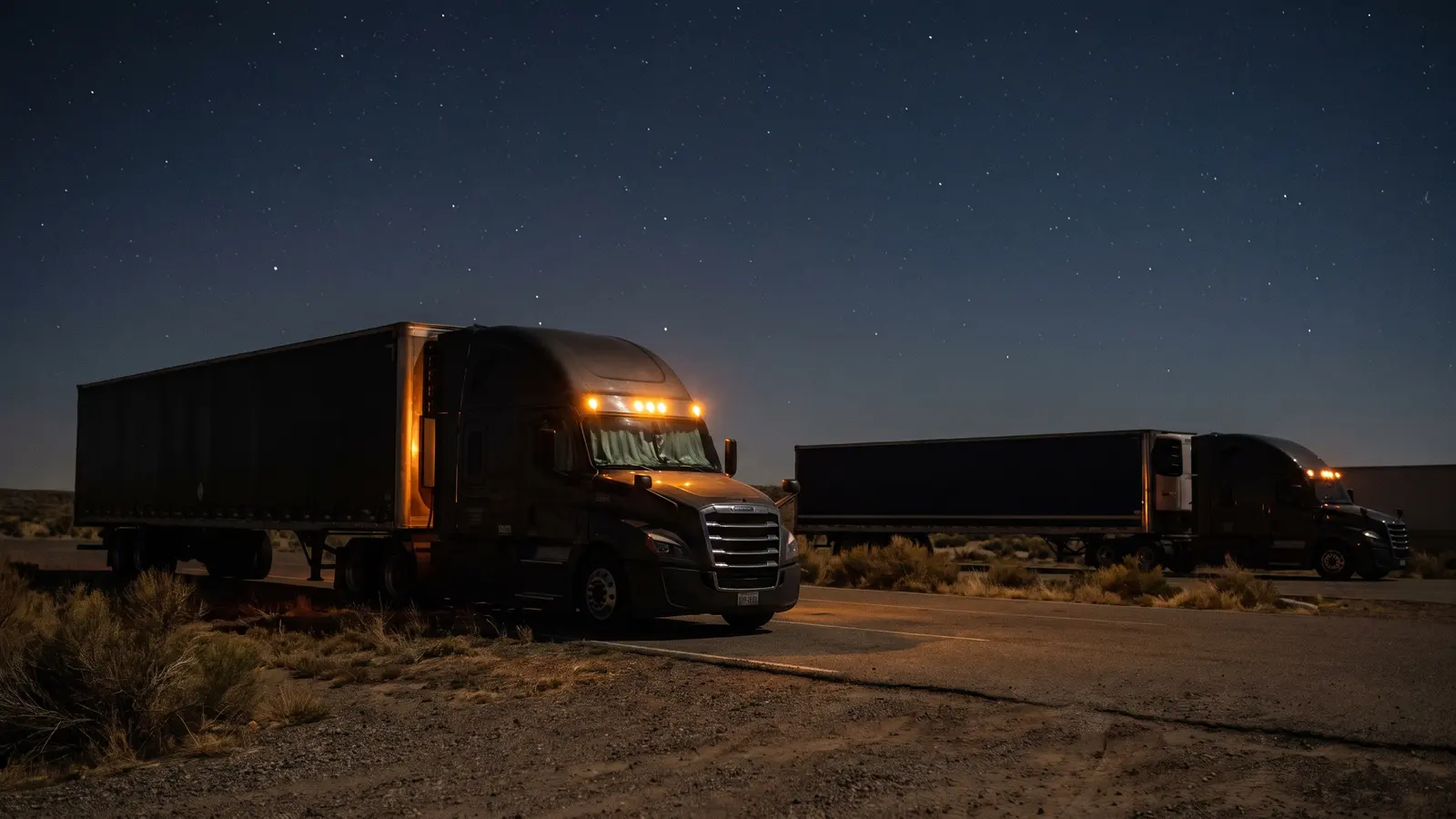
Commercial truck drivers in interstate commerce must follow the federal hours of service (HOS) regulations. These rules set the maximum time a driver can work and the minimum time a driver must rest before working again. This article covers the rules for property-carrying drivers.
How many hours can a truck driver drive?
In short, a property-carrying driver can drive up to 11 hours after 10 consecutive hours off duty, within a 14-hour window, while following the other hours of service rules below (49 CFR 395.3).
Duty status categories
- Off duty (line 1): not working, not required to be ready to work and with no responsibility to perform work. The driver is free to pursue his or her own interests (for example, meal stops, time at home or relaxing at a truck stop).
- Sleeper berth (line 2): time spent resting in the sleeper berth.
- Driving (line 3): time spent at the controls of a commercial motor vehicle (CMV) in operation, including sitting in traffic waiting to move.
- On duty not driving (line 4): time from when the driver begins work or must be ready to work until relieved from work, such as loading or unloading, inspections, training, fueling and other non-driving work directed by the carrier.
The hours of service regulations are in 49 CFR Part 395, developed and enforced by the Federal Motor Carrier Safety Administration (FMCSA), part of the U.S. Department of Transportation. The limits for property-carrying drivers are in 49 CFR 395.3. The rules and main exceptions are summarized below.
11-hour driving limit
After 10 consecutive hours off duty, a property-carrying driver may drive up to 11 hours.
14-hour window
A driver may not drive beyond the 14th hour after coming on duty, following 10 consecutive hours off duty. Off-duty time, including a long wait at a shipper, does not pause or extend the window. A driver may still do non-driving work after the 14th hour, but may not drive again until taking another 10 consecutive hours off. The one exception is a properly paired split-sleeper period, explained below.
30-minute break
A driver must take a 30-minute break after 8 cumulative hours of driving without at least a 30-minute interruption. Any 30 consecutive minutes not driving counts: off duty, sleeper berth, on duty not driving (such as fueling or waiting to load), or a mix of these.
60/70-hour limit
A driver may not drive after 60 hours on duty in 7 consecutive days, or after 70 hours on duty in 8 consecutive days if the carrier operates vehicles every day of the week. The count rolls forward, so hours from the oldest day drop off as each new day starts.
34-hour restart (optional)
A driver may restart the 7- or 8-day period by taking 34 or more consecutive hours off duty. The restart is a choice, not a requirement.
10-hour break
The 10-hour break is 10 consecutive hours off duty, in the sleeper berth, or a combination of the two.
Sleeper berth split (7/3 or 8/2)
A driver with a sleeper berth may split the 10 hours into two periods: at least 7 consecutive hours in the sleeper berth, and a separate period of at least 2 hours off duty or in the sleeper berth. The two periods must add up to at least 10 hours, so a 7/3 or an 8/2 split both work. When the two periods are properly paired this way, neither one counts against the 14-hour window (FMCSA split sleeper guidance). The driving time before and after the rest periods must still fit within the 11-hour and 14-hour limits. Many carriers set their own policy on split sleeper use, so drivers should ask.
Other exceptions
The rules allow some exceptions, and it is up to each driver and carrier to apply them only when the facts fit. Check the regulation and FMCSA's guidance before relying on any of them.
- Short-haul exception: a driver who stays within a 150 air-mile radius of the normal work reporting location, returns there, and is released within 14 consecutive hours may keep a time record instead of a log for that day. On a day the driver goes past 150 air miles or 14 hours, a full record of duty status is required for that day (49 CFR 395.1).
- Adverse driving conditions: when a driver meets conditions that could not have been known at dispatch, such as snow, fog or an unexpected road closure, the 11-hour driving limit and the 14-hour window can each be extended by up to 2 hours. Normal traffic does not count.
- Personal conveyance: a driver may record moving the truck for personal reasons as off duty, but only after being fully released from work by the carrier, and only when the trip is for the driver's own purposes, not the carrier's business. See FMCSA's personal conveyance guidance.
- Yard moves: driving done in a yard or similar area closed to public traffic can be recorded as on duty not driving instead of driving.
- Emergency relief: drivers providing direct assistance during certain declared emergencies may be relieved from some hours of service limits.
Common questions about how long truckers can drive
How many hours can a team driver drive?
The limits are the same for team and solo drivers. Each team plans its driving and rest so that both drivers stay within the rules and keep the truck moving.
How many miles can a truck driver legally drive in a day?
The regulations limit time, not miles. A driver can cover as many miles as the time allows, provided all other traffic laws are followed and fatigue or illness isn't compromising safety.
What happens if a driver violates the hours of service rules?
Drivers may be placed out of service and fined for a violation (for example, a 14-hour rule violation), falsifying logs or failing to record a duty status. Violations also count against the carrier in FMCSA's Safety Measurement System (CSA), and civil penalties are possible depending on the severity. For help with logs and ELD compliance, see our hours of service and ELD compliance page.
Are the hours of service rules changing?
The rules above are the current federal rules (FMCSA hours of service summary). FMCSA has announced pilot programs that test other ways to split off-duty time and more flexibility in the 14-hour window (FMCSA announcement). Pilot flexibilities apply only to drivers formally enrolled in a program. Every other driver runs on the rules above. Check fmcsa.dot.gov for the current status of any pilot.
Logistical Forwarding Solutions. A carrier-first company.