
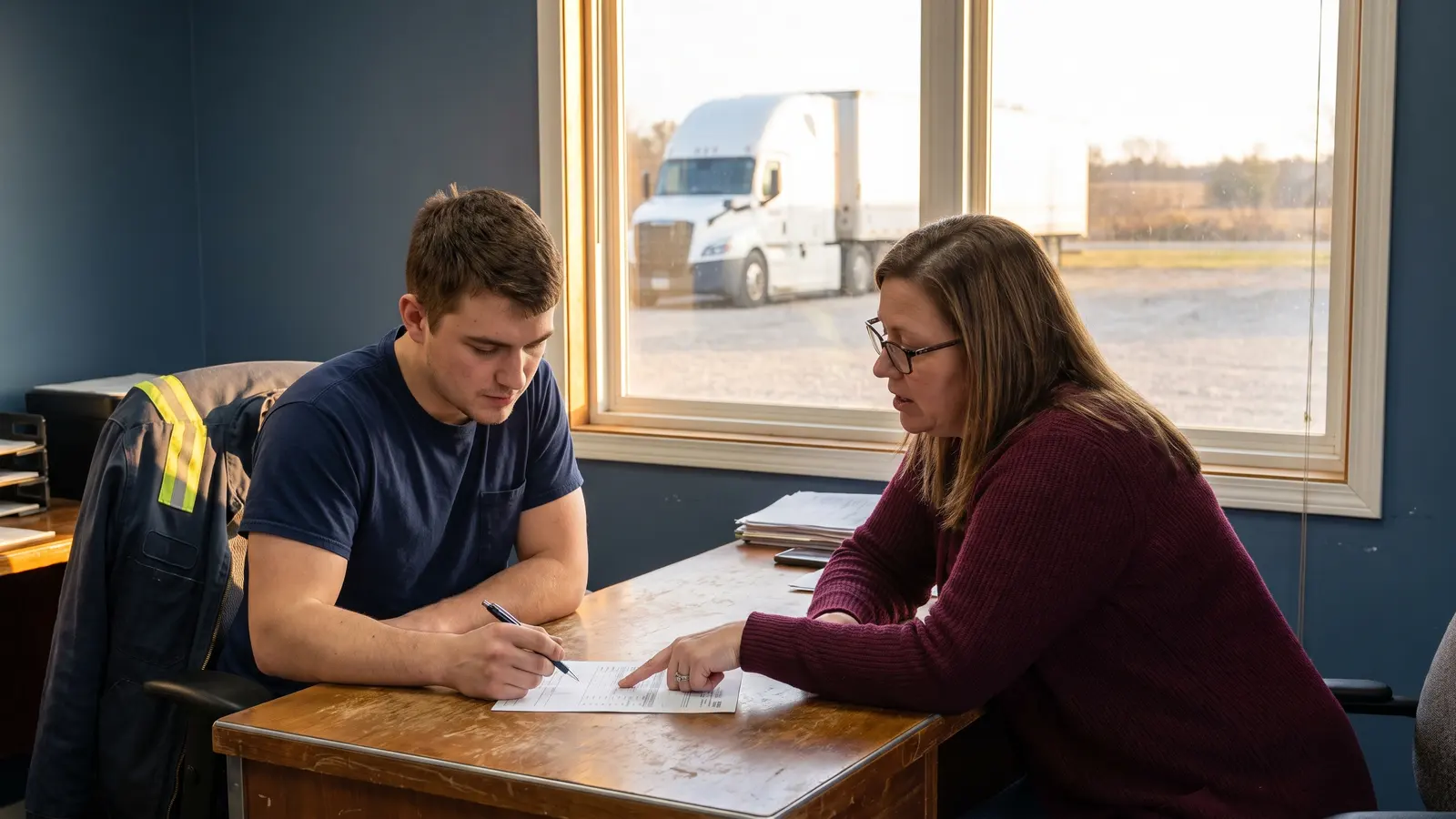
How to onboard a new truck driver, step by step
Knowing how to onboard a new truck driver the DOT way keeps a good hire from turning into an audit problem. We take you through every Part 391 and Part 382 step in order and build the driver qualification file as we go.
Why the order of onboarding matters
When you onboard a new truck driver, federal rules decide what has to happen before that driver moves a load. Some checks can be finished shortly after hire: the inquiry into the driver's state driving records, for example, can be made within 30 days of hire (49 CFR 391.23). Others must be done before the first trip. A driver may not perform safety-sensitive work until you have a verified negative pre-employment drug test result (49 CFR 382.301) and have run a full pre-employment Clearinghouse query (49 CFR 382.701).
Getting the order wrong is costly. Using a driver without a valid CDL, or a driver who is not medically qualified, is on the list of violations that fail a new entrant safety audit automatically (49 CFR 385.321). Those are hiring mistakes, and they happen in the first week, not the first year.
The DOT steps to onboard a new truck driver, in order
These steps come from 49 CFR Part 391 and Part 382. Each one leaves a record that belongs in the driver's file.
Employment application
The driver completes an application with the information 49 CFR 391.21 requires.
Driving records and past employers
Request the driving record from each state where the driver held a license in the past 3 years, within 30 days of hire, and ask prior employers for the driver's safety performance history over the past 3 years (49 CFR 391.23).
Road test
Give a road test, or accept an equivalent that the rules allow (49 CFR 391.31 and 391.33).
Medical qualification
Confirm the driver is medically qualified and keep a copy of the medical examiner's certificate (49 CFR 391.41–391.45). Certificates are issued for up to 24 months, so note the expiration date.
Clearinghouse query and drug test
Run the full pre-employment Clearinghouse query and get a verified negative pre-employment drug test result before the first safety-sensitive work. Then add the driver to your random pool.
See our drug and alcohol program service.
Complete the qualification file
Put every record in the driver qualification file. Keep it while the driver works for you and for 3 years after (49 CFR 391.51). Our DQ file service covers this in depth.
DOT driver hiring checklist
Before the first load, the driver's records should include:
- Completed employment application
- Driving record request for each state licensed in the past 3 years
- Safety performance history requests to prior employers for the past 3 years
- Road test record, or the equivalent you accepted
- Medical examiner's certificate, with the expiration date noted
- Full pre-employment Clearinghouse query result
- Verified negative pre-employment drug test result
- Signed receipt of your drug and alcohol policy
- Driver added to your random testing program
New CDL holders and entry-level driver training
If your new hire got a Class A or Class B CDL for the first time on or after February 7, 2022, entry-level driver training applied to that license (49 CFR Part 380, Subpart F). Training providers are listed on FMCSA's Training Provider Registry.
A newly licensed driver often has a short driving record and few or no prior employers to check. That makes the rest of the file, and your own orientation, carry more weight. Before the first trip, go over your hours of service and ELD procedures with the driver so the first week of logs is clean.
What LFS does for your onboarding
We run the onboarding paperwork with you, or for you, from application to first dispatch. We send the requests, track the answers, help schedule the pre-employment drug test, run Clearinghouse queries with your authorization, and build the file as the pieces come in.
After the driver starts, we track the dates that keep running: the medical certificate, the annual review of the driver's record (49 CFR 391.25) and the annual Clearinghouse query.
- Application to first dispatch
- Records requested and tracked
- Drug test and Clearinghouse coordinated
- Renewal dates watched
Backed by education
Our help with onboarding new drivers is backed by the education we created at Freight University. We use education, data, technology and academics to stay on top of the newest FMCSA rules and regulations. You don't get one person. You get a team, a platform and a network with up-to-date information, making sure it's done the right and correct way. How we work.
- Current on the newest FMCSA rules
- A team, a platform and a network behind you
- Done the right and correct way
Want the long version?
Our article on 13 steps to hiring a new truck driver the right way goes through the hiring side in more detail, from the job post to the first load.
Questions and answers
What documents do I need to hire a truck driver?
An employment application, state driving records for the past 3 years, safety performance history from prior employers, a road test or accepted equivalent, a medical examiner's certificate, a full Clearinghouse query and a verified negative pre-employment drug test. See the checklist above.
Can a new driver start before the drug test result comes back?
No. The driver may not perform safety-sensitive work until you have a verified negative result (49 CFR 382.301).
How far back do I check a new driver's record?
Three years. Request the driving record from each state where the driver was licensed in the past 3 years within 30 days of hire, and ask prior employers for 3 years of safety performance history (49 CFR 391.23).
How long is a DOT medical certificate good for?
Up to 24 months. The medical examiner can issue it for a shorter period (49 CFR 391.45).
How long do I keep a driver qualification file?
For as long as the driver works for you and 3 years after (49 CFR 391.51).
Does a new CDL holder need entry-level driver training?
People getting a Class A or B CDL for the first time on or after February 7, 2022 must complete entry-level driver training (49 CFR Part 380, Subpart F).
Related
Driver qualification files done right
Every carrier must keep a qualification file for every driver it uses. The file shows the driver was checked before the first load and is still qualified today.
Your DOT drug and alcohol testing program, set up and managed
A DOT drug and alcohol testing program is one of the first things an investigator checks and one of the easiest things to let slip.
13 Steps to Hiring a New Truck Driver the Right Way
How to hire truck drivers the right way: a 13-step checklist covering the driver application, PSP inquiry, MVR, medical card and drug testing.
Hours-of-service and ELD compliance
Hours-of-service violations are among the easiest to find, because the ELD records every minute.
DOT compliance services for trucking companies
Most small carriers don't lose their authority because they can't find freight. They lose it because they can't show an investigator the records that prove the company…
CDL-A driver jobs in the LFS network
LFS recruits and screens CDL-A drivers for the trucking companies in the LFS network, running 53-foot dry van and refrigerated freight.
How we work: backed by education
Everything we do at Logistical Forwarding Solutions is backed by education. Your company is managed by LFS, and behind LFS is Freight University: students, interns and…
Get help onboarding a driver
Tell us when your new driver should start and what paperwork you already have. We'll tell you what's left and in what order.
Prefer the phone? Call 901-205-9679.
Sources
- 49 CFR Part 391 — Qualifications of drivers
- 49 CFR 391.21 — Application for employment
- 49 CFR 391.23 — Investigation and inquiries
- 49 CFR 391.25 — Annual inquiry and review of driving record
- 49 CFR 391.31 — Road test
- 49 CFR 391.33 — Equivalent of road test
- 49 CFR 391.41 — Physical qualifications for drivers
- 49 CFR 391.43 — Medical examination; certificate of physical examination
- 49 CFR 391.45 — Persons who must be medically examined and certified
- 49 CFR 391.51 — General requirements for driver qualification files
- 49 CFR 382.301 — Pre-employment testing
- 49 CFR 382.701 — Drug and Alcohol Clearinghouse queries
- 49 CFR 385.321 — Safety audit: Failure
- 49 CFR Part 380, Subpart F — Entry-level driver training
- FMCSA Training Provider Registry