
Buying your first semi truck
The first truck is the biggest purchase most new carriers make, and the one that is hardest to undo. Buy it for the freight you will haul, inspect it like your business depends on it, and keep enough cash to run it.
Start with the freight, not the truck
We tell every new owner the same thing: the freight chooses the equipment. Before you look at a single listing, know what you will haul and where. A truck that is right for regional reefer work may be wrong for long-haul dry van, and power only work has its own needs.
If you have not done that research yet, start with how to start a trucking company and our freight research service.
Spec the truck for 80,000-pound freight
LFS works with 53-foot dry van, reefer and power only freight at 80,000 pounds. For that work most owners look at a sleeper tractor with a proven engine and transmission, a maintenance history you can read, and fuel economy that fits your cost per mile.
Two filings follow the truck, not the company. If its taxable gross weight is 55,000 pounds or more, it owes the federal heavy vehicle use tax on IRS Form 2290. And it needs apportioned (IRP) plates from your base state before it crosses state lines.
- Sleeper or day cab, by your lanes
- Engine and transmission with parts and service near your routes
- Records you can verify, not a seller's word
- A payment your cost per mile can carry
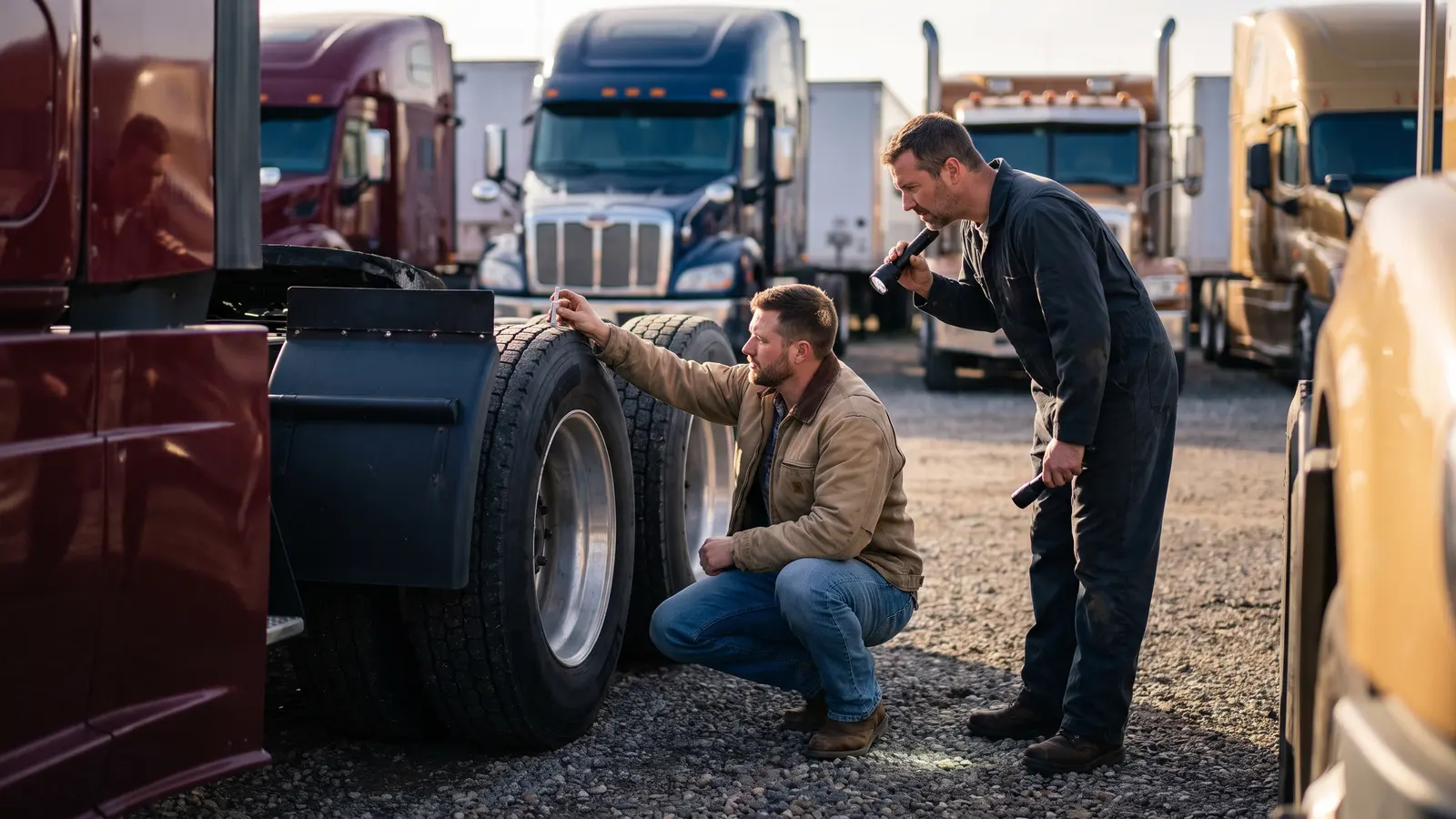
Used semi truck inspection checklist
Have a qualified heavy-duty mechanic check these before you pay. Never skip it because the truck looks clean.
- Engine computer (ECM) report: hours, idle time, fault codes, overspeed and hard braking
- Oil sample sent for analysis
- Emissions system history: DPF, DEF and EGR repairs and cleanings
- Frame rails and crossmembers checked for cracks, welds and rust
- Brakes, air lines and air system leak-down test
- Tires: tread depth, matching sets and age
- Steering, suspension and fifth wheel wear
- Cab electrical, gauges, lights and sleeper heating and cooling
- Open recalls checked by VIN
- Full maintenance records compared to the odometer and ECM hours
- Current annual inspection report or decal on the truck
- Title matches the VIN and the seller's name; no open liens
- Road test, loaded if the seller will allow it
Paying for it on a new authority
Expect lenders to be careful
Lenders see a new authority as a higher risk. Expect a larger down payment and a higher rate than an established carrier would get. Read every term before you sign.
Cash or financing
We ask every new owner: are you buying with cash or financing, and do you have maintenance reserves? Paying cash for an older truck can leave you with no repair money. Financing a newer one can leave you with a payment the freight cannot cover.
Do not spend your reserve
The truck is only the first bill. You still need the insurance down payment, registration and permits, and money to run while you wait to be paid. Buy the truck you can afford to run, not the one you can barely afford to buy.
Your first truck with education behind it
Before you buy, a team with Freight University's education behind it does the freight research for your lanes, so your truck is matched to the freight that's really there. How we work.
- Freight research before you buy
- The right truck for your lanes
- A team behind your company
Want help finding and checking the truck?
LFS brokers the purchase and sale of commercial semi trucks. We help you find a truck that fits your freight, get it inspected, and handle the paperwork. See our commercial truck sales broker service.
Questions and answers
Should my first truck be new or used?
Most first-time owners buy used to keep the payment manageable. A used truck with good records and a clean inspection can be a sound buy. A used truck with no records is a gamble with your whole business.
Does a used truck need an annual inspection?
Yes. Federal rules require each commercial vehicle to pass a periodic inspection at least once in the preceding 12 months, with proof kept on the vehicle (49 CFR 396.17). Ask for the current report before you buy.
Can LFS help me sell the truck later?
Yes. Our truck sales broker service works for sellers as well as buyers.
Related
How to start a trucking company the right way
This is the order we walk new carriers through: the filings in the sequence FMCSA expects them, and the business numbers alongside, so the truck you buy has freight that…
Commercial truck sales broker
LFS brokers the purchase and sale of commercial semi trucks. We help buyers find a truck that fits their freight and budget, and help sellers move a truck to a buyer who…
Commercial truck insurance for new carriers
Insurance is usually the largest bill a new trucking company pays, and it is the one that can shut you down if it lapses.
Freight research for trucking companies
Freight research means finding the shippers and lanes that fit your equipment before the truck rolls, not after it is sitting empty. It is where every good load starts.
Fleet management for small trucking fleets
Day-to-day fleet management for owner-operators and small fleets: maintenance scheduling, maintenance records, repair coordination and driver coordination, so your…
How we work: backed by education
Everything we do at Logistical Forwarding Solutions is backed by education. Your company is managed by LFS, and behind LFS is Freight University: students, interns and…
Looking for your first truck?
Tell us what freight you plan to haul and what you are looking for. We will reply with what to look for and how we can help.
Prefer the phone? Call 901-205-9679.