

How to start a trucking company the right way
This is the order we walk new carriers through: the filings in the sequence FMCSA expects them, and the business numbers alongside, so the truck you buy has freight that pays for it. We are a carrier-first company, and this guide is written for the person who will own the truck.
Before you file anything, research the freight
Most new trucking companies start with the truck. That is backwards. We teach that understanding the freight comes first, because the freight decides everything after it: the equipment, the lanes, the insurance and the kind of driver you need.
The trucking companies LFS builds and manages run 53-foot dry van, refrigerated (reefer) and power only freight at 80,000 pounds. Each one is a different business. Reefer pays differently and asks more of the driver and the equipment. Power only needs no trailer of your own but depends on steady trailer pools. Dry van is the widest market and the most crowded.
Before you spend money, find out which lanes run out of your area, what they pay, and how often you would be empty coming back. Our freight research service does this work, and how to understand trucking lanes explains the basics.
The filing order, step by step
Do these in order. Each one depends on the one before it.
Form the business and get an EIN
Most carriers form an LLC in their home state, then get an Employer Identification Number from the IRS. The EIN application is free on irs.gov. Open a business bank account so the truck's money never mixes with yours.
Apply for your USDOT number and MC authority
You need a USDOT number if you run interstate with a vehicle of 10,001 pounds or more (FMCSA). To haul other people's freight for hire across state lines, you also need operating authority (your MC number). You apply for both online. In 2026 FMCSA moved registration to Motus, its new USDOT Registration System, which replaced the older Unified Registration System, and new registrants must pass an identity verification check. The fee is $300 for each type of authority.
File your BOC-3 process agent
A process agent is the person court papers can be served on in a state. Carriers designate one for each state they operate in, on form BOC-3. Most new carriers use a blanket company that covers every state and files the BOC-3 for them.
Have your insurer file proof of insurance
For-hire carriers of general freight in vehicles of 10,001 pounds or more must carry at least $750,000 in liability coverage (49 CFR 387.9). Your insurance company files it with FMCSA on form BMC-91 or BMC-91X. If it is not filed within 20 days after your application is published in the FMCSA Register, FMCSA will dismiss the application unless you comply within 60 more days (FMCSA). See commercial truck insurance for new carriers.
Register UCR, Form 2290, IRP and IFTA
Register for UCR every year; the fee depends on how many vehicles you run. If your truck's taxable gross weight is 55,000 pounds or more, file IRS Form 2290 for the heavy vehicle use tax. The tax year runs July 1 to June 30, the return is due by the last day of the month after the truck's first use, and the stamped Schedule 1 is your proof of payment when you register the truck. Your base state then issues apportioned plates (IRP) and your IFTA fuel tax license.
Set up drug and alcohol testing and the Clearinghouse
Before any CDL driver works for you, including you, they need a pre-employment drug test with a verified negative result (49 CFR 382.301). You must run a pre-employment Clearinghouse query and query every driver at least once a year (382.701). If you drive for your own company, you must designate a consortium/third-party administrator in the Clearinghouse (382.705(b)(6)). Most one-truck companies run random testing through that consortium.
Your company built through development
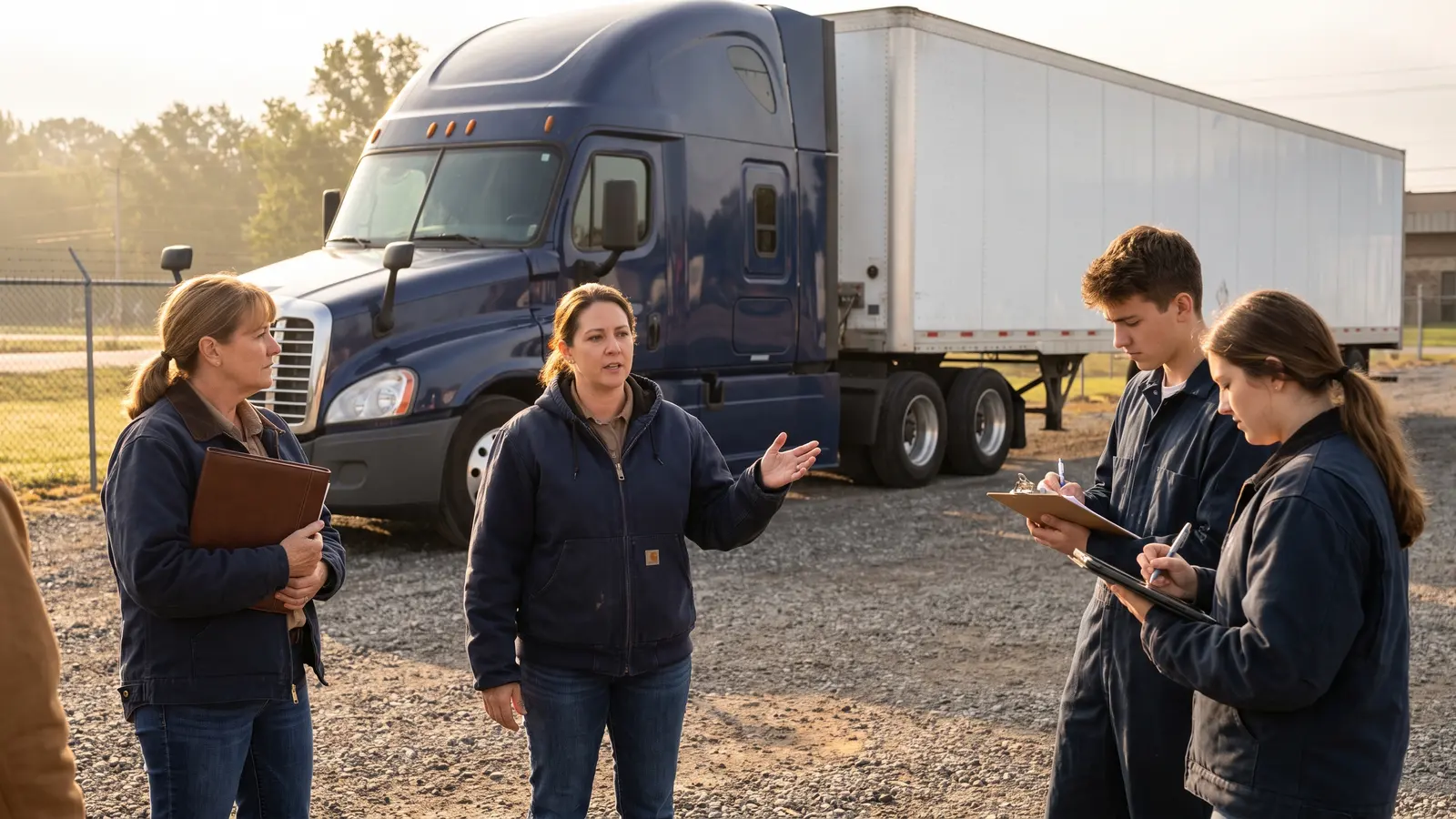
When LFS builds your trucking company, we place students, academics and interns into your situation. We call that development.
There is a team making sure your company is built the right way under the Code of Federal Regulations, with freight research, a back office system and everything else it needs. You don't just get a company behind you. You get education behind you. How we work.
- Freight research for your lanes
- Compliance built to the federal regulations
- A back office system from day one
Your first 18 months: the new entrant safety audit
FMCSA watches new carriers closely for their first 18 months and conducts a safety audit within 12 months after you begin operations (FMCSA New Entrant Safety Assurance Program). Certain findings fail the audit automatically. Build your files from the first day, not the week before the auditor calls. A mock audit and clean driver qualification files are the surest way to be ready. See our DOT compliance services.
- No drug and alcohol testing program, or no random testing
- Using a driver with an invalid CDL or who is medically unqualified
- Drivers not keeping hours-of-service records
- Operating without the required insurance
- Running a truck that has not had its periodic inspection
- Using an out-of-service vehicle before it is repaired

The business side
The filings make you legal. These decide whether you are still in business next year.
Know your cost per mile
Add up every fixed cost (truck payment, insurance, permits, phone) and every running cost (fuel, tires, maintenance, driver pay) and divide by the miles you expect to run. That number is your floor. A load below it loses money no matter how good it looks.
Keep a cash reserve
You will deliver a load and wait to be paid. Plan for that gap, plus the insurance down payment and a repair fund. Our advice: build the company while you still have your income. Cash flow gives you time to grow carefully.
Choose your equipment
Dry van, reefer or power only. Let your freight research choose it. Each one changes your insurance, your maintenance and the brokers who will call you.
Buy the right first truck
Match the truck to the freight, inspect it properly, and do not drain your reserve to buy it.
Plan how you get paid
Know how you will invoice, how fast brokers pay, and whether you will use factoring. Delivered is not done until the money is in the bank.
Decide who runs the back office
Billing, paperwork, compliance dates and load booking take hours every week. Decide early whether you do it or hire it out.
Startup checklist
Print this and check it off as you go.
- Freight researched: lanes, rates and equipment type chosen
- Cost per mile worked out and cash reserve set aside
- LLC formed and EIN issued
- Business bank account open
- USDOT number and MC operating authority applied for
- Identity verification completed with FMCSA
- BOC-3 filed by a process agent
- Liability insurance filed with FMCSA (BMC-91 or BMC-91X)
- Cargo and physical damage coverage in place
- Authority showing active before the first load
- UCR registration paid
- Form 2290 filed and Schedule 1 in hand
- IRP plates and IFTA license from your base state
- Drug and alcohol program and consortium set up
- Clearinghouse registered and queries run
- Driver qualification file complete for every driver
- Annual inspection on the truck and a maintenance file started
- ELD installed and drivers trained on hours of service
One truck is a straight line
The Art of the Deal with 10 Wheels puts it this way: "One truck is a straight line. A business built right turns in circles." Research leads to the right load, the load to billing, billing to cash, and cash keeps your compliance current. LFS builds trucking companies and manages them as part of the LFS network. Each company in the network operates under its own USDOT number and operating authority, not ours, with LFS management and compliance oversight behind it. If you want help building that circle from the start, talk with us about trucking business consulting.
Questions and answers
How long does it take to start a trucking company?
It depends mostly on how fast your insurance is filed and your authority becomes active. FMCSA gives you 20 days after your application is published in the FMCSA Register to get insurance on file before it moves to dismiss the application (FMCSA). Have your insurance quote and process agent lined up before you apply.
Can I start a trucking company with one truck?
Yes. Most carriers start with one truck. The risk is that one truck has no backup: one breakdown or one unpaid load can stop the business. That is why the cash reserve and the freight research matter more than the truck. Read why small trucking companies fail.
Do I need cargo insurance?
Federal rules do not set a cargo minimum for general freight carriers; the $750,000 federal minimum is liability (FMCSA). In practice, nearly every broker and shipper will ask for cargo coverage before they give you a load.
What is the new entrant safety audit?
It is FMCSA's review of a new carrier's safety records within 12 months after operations begin. It looks at your drug and alcohol program, driver files, hours of service, insurance and vehicle maintenance (FMCSA).
Related
New entrant safety audit preparation
Every new interstate carrier gets a new entrant safety audit. We help you get your records in order before it happens, and if the audit doesn't go your way, we help you…
Get your trucking authority set up
Your authority is what lets you haul other people's freight across state lines for pay.
Commercial truck insurance for new carriers
Insurance is usually the largest bill a new trucking company pays, and it is the one that can shut you down if it lapses.
Buying your first semi truck
The first truck is the biggest purchase most new carriers make, and the one that is hardest to undo.
More than dispatch: logistics support for your trucking company
Our dispatch service is 8% of the gross of each load, and it is more than dispatch.
DOT compliance services for trucking companies
Most small carriers don't lose their authority because they can't find freight. They lose it because they can't show an investigator the records that prove the company…
Trucking business consulting
Our founder, Michael Thomas, has spent more than 25 years in freight: brokering loads, building trucking companies and teaching the people who run them.
How we work: backed by education
Everything we do at Logistical Forwarding Solutions is backed by education. Your company is managed by LFS, and behind LFS is Freight University: students, interns and…
Starting a trucking company?
Tell us where you are in the process and what freight you are thinking about. A member of our team will reply by email or phone.
Prefer the phone? Call 901-205-9679.
Sources
- FMCSA — Do I need a USDOT number?
- FMCSA — Registration (Motus, the USDOT Registration System; identity verification)
- FMCSA — What is the cost of obtaining operating authority?
- FMCSA — Process agents
- FMCSA — Insurance filing requirements
- FMCSA — Insurance requirements (20-day filing and 60-day dismissal)
- 49 CFR 387.9 — Financial responsibility, minimum levels
- IRS — Get an Employer Identification Number
- IRS — Instructions for Form 2290 (rev. July 2026)
- UCR Plan — Fee brackets
- 49 CFR 382.301 — Pre-employment testing
- 49 CFR 382.701 — Drug and Alcohol Clearinghouse queries
- 49 CFR 382.705 — Reporting to the Clearinghouse (C/TPA designation)
- FMCSA — New Entrant Safety Assurance Program