
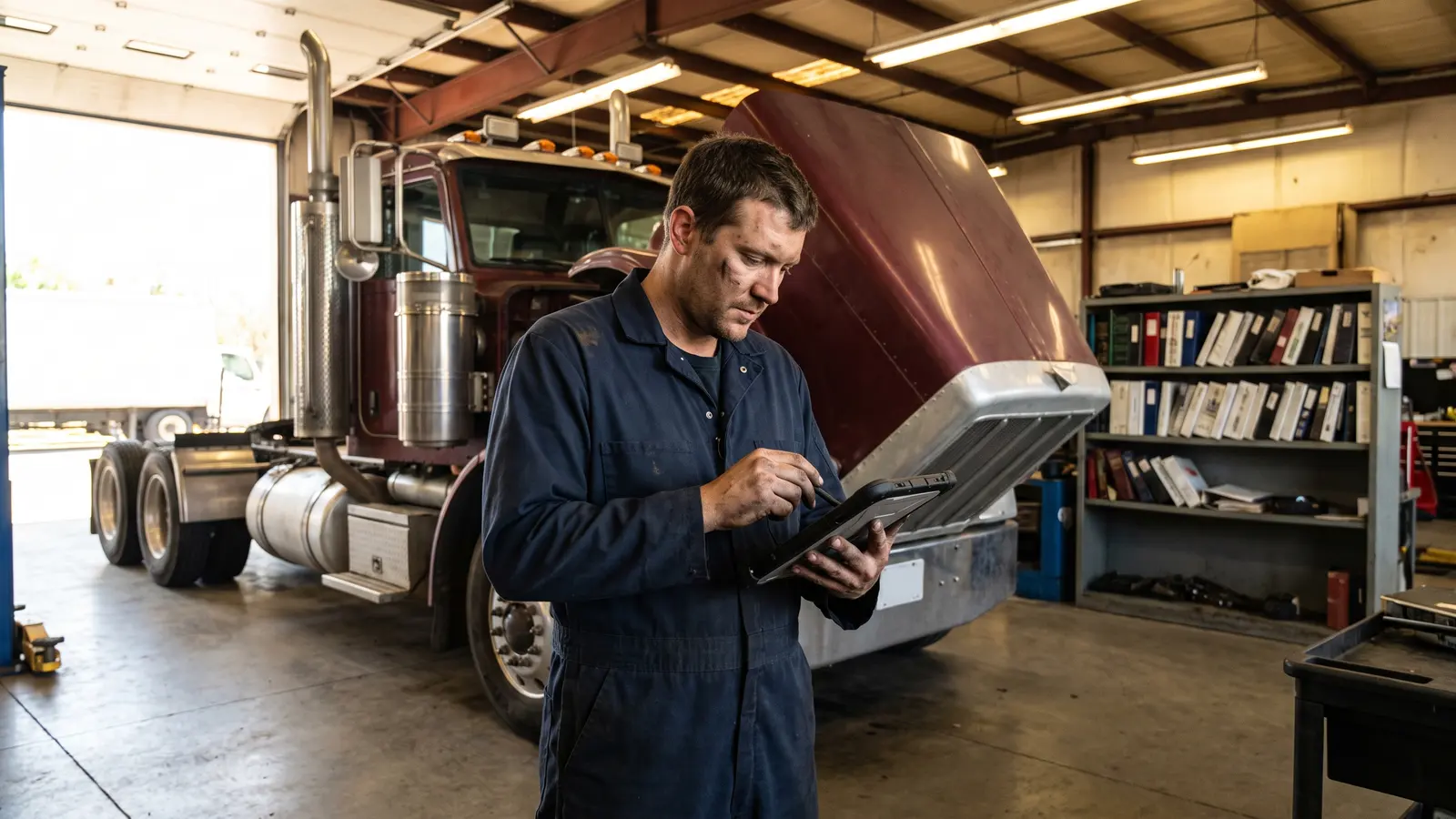
DOT vehicle maintenance records, set up and kept current
DOT vehicle maintenance records show that you inspect, repair and maintain every truck and trailer you control. We set up a file for each unit, a driver inspection routine and a maintenance calendar you can keep up with.
What DOT vehicle maintenance records Part 396 requires
49 CFR Part 396 requires you to systematically inspect, repair and maintain the vehicles you control, and to keep records that prove it. Under 49 CFR 396.3, you keep those records for each vehicle you control for 30 consecutive days. Keep them for one year, and for six months after the vehicle leaves your control.
Three other records sit alongside the maintenance file:
- Driver vehicle inspection reports (DVIRs). Reports under 49 CFR 396.11 are kept for three months.
- Periodic (annual) inspection. Each vehicle needs one at least every 12 months, with documentation kept on the vehicle (49 CFR 396.17). The inspection report is kept for 14 months (49 CFR 396.21).
- Inspector qualifications. The person doing the annual inspection must meet the qualifications in 49 CFR 396.19.
None of this is complicated, but it is easy to fall behind with a small fleet. One truck in the shop, a driver who forgets to turn in a report, a trailer picked up on a lease, and the file has a gap. Our job is to keep the gaps from piling up.
What goes in each vehicle file
This is how we organize each file so the required records are easy to find. If your records live in a glovebox, a shoebox and three email inboxes, that's fine. That's where we start.
Unit identification
Unit number, make, year and serial number on the first page, so every record ties to one vehicle.
Inspection, repair and maintenance log
Every inspection, repair and service in one running record, as 396.3 requires.
Driver inspection reports
The last three months of DVIRs, with notes on how each reported defect was handled.
Annual inspection
The current periodic inspection report and the due date for the next one.
Inspector qualification
A record showing the annual inspector meets 396.19.
Out-of-service repairs
Repair records for any out-of-service order. Using a vehicle declared out of service before it is repaired is an automatic-failure violation for new entrants (49 CFR 385.321).
How we set up your maintenance files
List your equipment
Every truck and trailer you control, owned or leased, and the date you took control of it.
Gather what exists
Shop invoices, past annual inspections, DVIRs and warranty records, sorted into one file per unit.
Fill the gaps
Where records are missing, we list what's needed, such as an overdue annual inspection by a qualified inspector.
Set the driver routine
Drivers get a simple DVIR process and a clear way to get reports to the office.
Build the calendar
Annual inspection due dates, service intervals from your shop or the manufacturer, and record retention dates for every unit.
Review on a schedule
As part of our fleet management or compliance work, we check the files regularly and flag what's coming due.
Your maintenance calendar
One line per unit, checked every week.
- Last annual inspection date and next due date (at least every 12 months)
- Preventive maintenance intervals set by your shop or the manufacturer
- DVIRs collected and filed, kept at least three months
- Annual inspection reports kept 14 months
- Open defects and out-of-service repairs closed before the unit is dispatched
- Units leaving your control flagged so their records are kept six more months
Why maintenance files matter at audit time
Vehicle records are part of every new entrant safety audit and every mock audit we run. Under 49 CFR 385.321, using vehicles without a periodic inspection, found on 51% or more of the records examined, fails a new entrant on its own. For a closer look at what an auditor asks for, read maintenance files for a DOT audit.
Good files help on the road too. A truck maintained on schedule gives an inspector fewer reasons to write it up, and over time that shows in your CSA scores.
Backed by education
Our help with vehicle maintenance files is backed by the education we created at Freight University. We use education, data, technology and academics to stay on top of the newest FMCSA rules and regulations. You don't get one person. You get a team, a platform and a network with up-to-date information, making sure it's done the right and correct way. How we work.
- Current on the newest FMCSA rules
- A team, a platform and a network behind you
- Done the right and correct way
We manage the records, your shop does the repairs
LFS doesn't repair trucks or perform annual inspections. Your shop or a qualified inspector does that work. We make sure it is scheduled, documented and filed. We are a carrier-first company, and we work remotely with carriers in all 48 contiguous states.
Questions and answers
What DOT vehicle maintenance records do I need to keep?
Inspection, repair and maintenance records for each vehicle you control for 30 consecutive days (49 CFR 396.3), driver vehicle inspection reports (396.11), and periodic inspection reports (396.17, 396.21).
How long do I keep DVIRs?
Three months (49 CFR 396.11).
How often is the annual DOT inspection required?
At least every 12 months, with documentation kept on the vehicle (49 CFR 396.17). Keep the inspection report for 14 months (49 CFR 396.21).
How long do I keep maintenance records after I sell a truck?
Six months after the vehicle leaves your control (49 CFR 396.3).
Does LFS repair or inspect trucks?
No. Your shop or a qualified inspector does that work. We set up the files, keep the calendar and follow up so nothing is missed.
Related
DOT Maintenance Records Requirements: What FMCSA Can Ask to See
DOT maintenance records requirements explained: what 49 CFR 396.3 requires, how roadside inspections can lead to audits and how to keep files ready.
DOT mock audits: find gaps before the investigator does
A mock audit is a practice run. We ask for the same records an FMCSA investigator would, check them against the regulations, and give you a written list of what's…
New entrant safety audit preparation
Every new interstate carrier gets a new entrant safety audit. We help you get your records in order before it happens, and if the audit doesn't go your way, we help you…
Fleet management for small trucking fleets
Day-to-day fleet management for owner-operators and small fleets: maintenance scheduling, maintenance records, repair coordination and driver coordination, so your…
Improve CSA scores and challenge incorrect data in DataQs
There is no shortcut to improve CSA scores. They change when fewer violations go on your record and when the data already there is accurate.
How we work: backed by education
Everything we do at Logistical Forwarding Solutions is backed by education. Your company is managed by LFS, and behind LFS is Freight University: students, interns and…
Set up your vehicle maintenance files
Tell us how many trucks and trailers you run and how you keep records today. We'll reply with a list of what to send.
Prefer the phone? Call 901-205-9679.
Sources
- 49 CFR Part 396 — Inspection, repair, and maintenance
- 49 CFR 396.3 — Inspection, repair, and maintenance
- 49 CFR 396.11 — Driver vehicle inspection report(s)
- 49 CFR 396.17 — Periodic inspection
- 49 CFR 396.19 — Inspector qualifications
- 49 CFR 396.21 — Periodic inspection recordkeeping requirements
- 49 CFR 385.321 — New entrant safety audit: automatic-failure violations