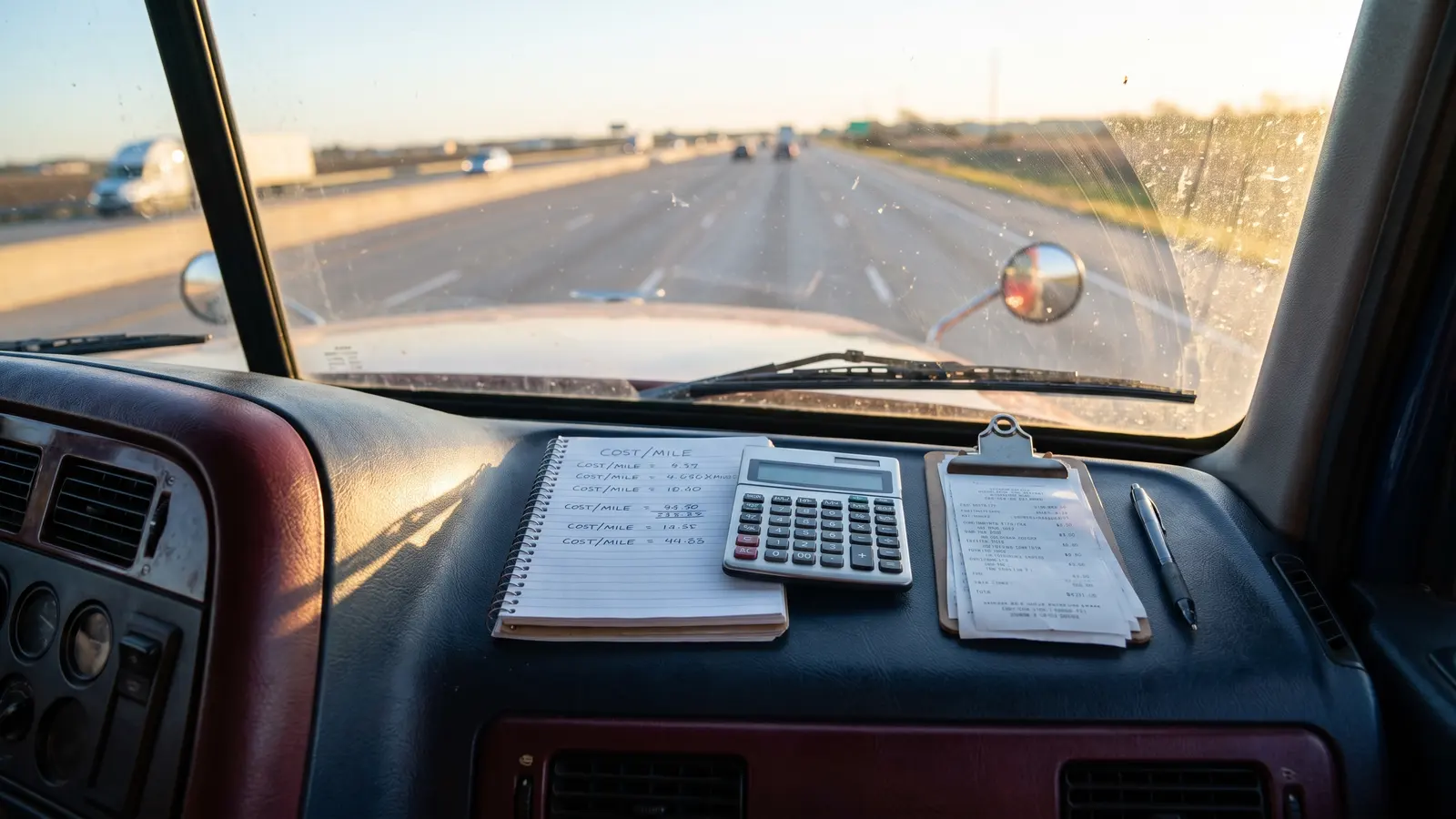
Your trucking cost per mile is everything it costs to run your truck for a period, divided by every mile the truck drove in that period, loaded and empty. If you spent $16,000 last month and drove 9,000 miles, your cost per mile is about $1.78. Any rate below that loses money. Any rate above it is the margin that keeps you open.
Every trucking company should know this number before it accepts a load. Most small carriers that fail never knew it.
How to calculate cost per mile
- Add up your fixed costs for the month: truck and trailer payments, insurance, permits and registrations, ELD and phone, software, and any office costs.
- Add up your variable costs for the same month: fuel, maintenance and repairs, tires, tolls, lumper and scale fees, and driver pay if you have a driver.
- Add them together. That's your total cost.
- Divide by total miles, including deadhead. Empty miles cost the same as loaded ones.
Cost per mile = total costs ÷ total miles
Use real numbers from your bank account, fuel cards and ELD, not estimates. Run it every month. Fuel and repairs move it constantly.
What does it cost per mile to run a truck?
ATRI publishes the most complete public look at what carriers actually spend. For 2025, it found an average of $2.336 per mile (ATRI):
| Cost | Per mile (2025) |
|---|---|
| Driver wages | $0.818 |
| Fuel | $0.482 |
| Truck and trailer payments | $0.404 |
| Repair and maintenance | $0.215 |
| Driver benefits | $0.210 |
| Insurance | $0.106 |
| Tires | $0.050 |
| Tolls | $0.043 |
| Permits and licenses | $0.008 |
| Total | $2.336 |
These are averages across the fleets ATRI surveyed. Small fleets reported higher repair and insurance costs. For an owner-operator, the driver wages and benefits lines are your own pay.
Adjust for today's diesel

Fuel is the line that swings the most, and it has swung hard. The national diesel average was about $6.20 a gallon in early October, almost $2.50 higher than a year earlier (EIA).
To get your fuel cost per mile, divide the price per gallon by your miles per gallon. At $6.20 and 6.5 miles per gallon, fuel costs about 95 cents a mile, roughly double ATRI's 2025 average. Rebuild your cost per mile with your own fuel number every month, or you will price loads off a number that's no longer true.
Your breakeven rate and target rate
Your breakeven rate is your cost per mile. At that rate you pay every bill and your truck, and you earn nothing extra.
Your target rate adds the profit and reserve you need on top:
Target rate per mile = cost per mile + your profit per mile + your reserve per mile
Then judge each load on all its miles. A load paying $2,500 for 900 loaded miles with 200 deadhead miles to reach it pays $2,500 ÷ 1,100 = about $2.27 per total mile, not $2.78.
Fuel surcharge matters too. Rates are often quoted as linehaul plus fuel. DAT's national spot averages for September 2026 were $2.17 a mile for dry van and $2.70 for reefer before fuel, with record fuel surcharges on top (DAT). ATRI found truckload carriers ran operating margins below 1% in 2025. There's very little room for guessing.
A one-truck example
Here is a month for a one-truck owner-operator, using example numbers. Put in your own.
| Monthly cost | Amount |
|---|---|
| Truck and trailer payments | $3,500 |
| Insurance | $1,200 |
| Fuel (9,000 miles at 6.5 mpg, $6.20/gal) | $8,585 |
| Repairs, maintenance and tires | $2,300 |
| ELD, phone, permits, software | $400 |
| Total (before paying yourself) | $15,985 |
$15,985 ÷ 9,000 miles = $1.78 per mile to run the truck. If you want to pay yourself $6,000 a month, that's another $0.67 a mile, so you need about $2.44 a mile across all your miles to cover the truck and your pay. A reserve for the next breakdown comes on top of that.
The numbers to watch every week
- Cost per mile: your floor.
- Revenue per mile, on total miles, not loaded miles.
- Deadhead percentage: empty miles divided by total miles.
- Fuel cost per week.
- Maintenance cost per mile.
- On-time delivery rate: it decides which brokers and shippers call you back.
What you don't measure will eventually collapse. A carrier that knows these numbers can say no to a bad load with confidence. A carrier that doesn't will haul itself out of business one cheap load at a time.
How LFS helps
We are a carrier-first company. LFS dispatch services start with your cost per mile, so every load we book is checked against it, and our freight research finds lanes that pay above it. For finding better freight, read how owner-operators find loads. If cash flow is the problem, see partnering with a factoring company.
Sources
Questions and answers
How do you calculate cost per mile in trucking?
Add up all your fixed and variable costs for a period, then divide by every mile the truck drove in that period, loaded and empty. If you spent $16,000 and drove 9,000 miles, your cost per mile is about $1.78.
What is the average cost per mile to run a truck?
ATRI found an average of $2.336 per mile in 2025, including driver wages and benefits. Fuel was 48 cents of that, but diesel has risen sharply since, so rebuild the number with today's fuel price.
What is a breakeven rate in trucking?
Your breakeven rate is your cost per mile. At that rate you cover every cost and earn nothing extra. Your target rate adds the profit and repair reserve you need on top.
Should deadhead miles count in cost per mile?
Yes. Empty miles burn the same fuel and wear the same tires as loaded ones. Divide your costs by total miles, and judge each load's rate on its loaded miles plus the deadhead to reach it.
Logistical Forwarding Solutions. A carrier-first company.